





How to Plan a Digital Product Launch in Asana (Step-by-Step Workflow)
Launching a digital product can feel like juggling 20 moving pieces at once, but Asana launch planning gives you a clear system to organize every task, timeline, and phase of your launch.
If your launches feel chaotic or last-minute, the issue isn’t your offer—it’s your system.
In this guide, we’ll walk through how to plan a digital product launch in Asana using a structured, phase-based workflow so your launch runs smoothly from start to finish.

The KSA Way – What our agency can do for you!
We are full service integrator agency for digital small businesses who are looking to scale and need a team of highly skilled integrators (that’s us!) who can help them reach their goals!
Some things we do on the daily:
- Evergreen funnel audits + builds
- Freebie funnel creation (copy, design, tech)
- Showit & Squarespace Design
- Sales pages + backend systems
Why Use Asana for Launch Planning?
Asana is one of the most powerful project management tools for organizing launches because it allows you to:
- Break large launches into manageable phases
- Assign tasks and responsibilities
- Set deadlines and dependencies
- Keep your entire team aligned
Instead of keeping your launch “in your head,” Asana gives you a centralized system to execute with clarity.
The 4 Phases of a Successful Launch in Asana
A well-executed launch is not built in a week—it’s built in phases.
1. Launch Planning (Strategy Phase)
This is your foundation.
Before creating content or building assets, define the big-picture details:
- Offer details (what you’re selling)
- Target audience (who it’s for)
- Pricing and positioning
- Success metrics (good, better, best outcomes)
- Launch timeline
- Team roles and responsibilities
This phase acts as your strategy hub—ensuring every decision ties back to the goal of the launch.
2. Lean-In Phase (4–6 Weeks Before Launch)
This is where execution begins.
In this phase, you build everything required for your offer:
- Outline your product or program
- Create templates, resources, and materials
- Record training or course content
- Set up your product inside Kajabi or your platform
- Draft launch emails and marketing content
By the end of this phase, your product should be fully built and ready to sell.
3. Pre-Launch Phase (1 Week Before Launch)
Now it’s time to prepare for launch week.
Focus on finalizing and testing:
- Sales page completion and edits
- Email scheduling
- Checkout links and integrations
- Automation checks (Zapier, tagging, delivery emails)
- Content batching (social posts, reels, stories)
This phase ensures everything is functional before you open the cart.
4. Launch Day Execution
Launch day should not feel chaotic.
Inside Asana, map out exactly what needs to happen:
- Send launch emails
- Publish social content
- Turn on banners and links
- Monitor engagement and sales
When everything is pre-planned, launch day becomes execution—not scrambling.
Using Asana Automations to Streamline Your Launch
If you’re using Asana’s advanced features, you can:
- Automatically assign tasks
- Create task dependencies
- Move tasks between phases
- Trigger workflows based on completion
Even without automations, simply organizing your launch into phases dramatically improves efficiency.
Why This System Works (Integrator Insight)
Most Visionaries struggle with launches because they’re trying to hold everything mentally.
An Integrator thinks differently:
- Systems first, execution second
- Clear phases instead of reactive work
- Defined responsibilities instead of guessing
This is how you move from overwhelmed to operational.
Final Thoughts
A successful launch is not about doing more—it’s about organizing better.
When your launch lives inside a structured Asana workflow, you:
- Reduce stress
- Improve execution
- Increase consistency
- Create repeatable systems for future launches
And that’s how you scale.
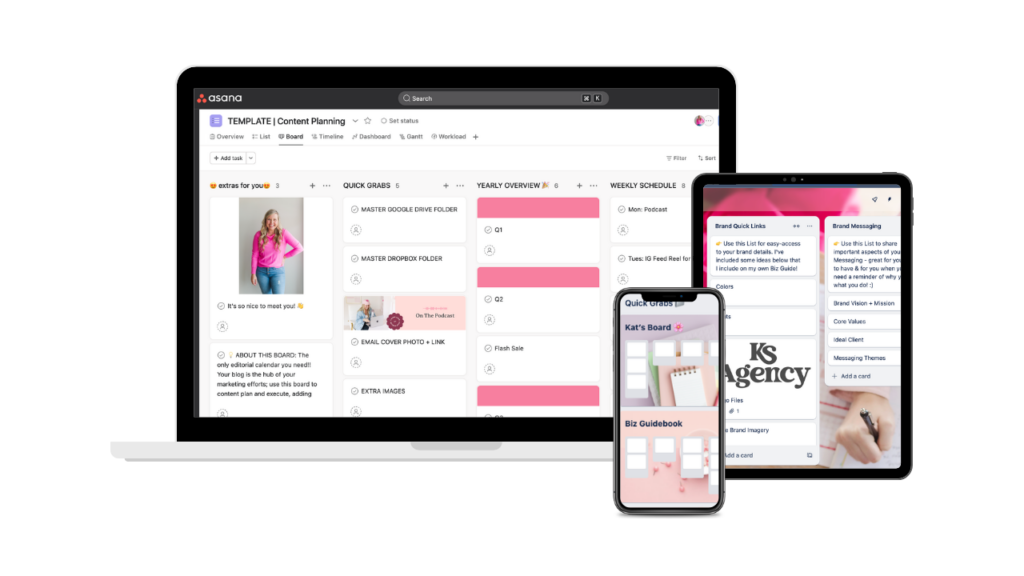
Need to get started organizing? Shop our Asana templates here!
An integrator is the person who turns a business owner’s vision into action! In a small business, an integrator owns execution: managing systems, projects, timelines, and teams so ideas don’t stall out. They’re hands-on, implementation-focused, and responsible for making sure strategy actually gets done!
Ideally, you should start planning your launch 4–6 weeks in advance so you have time to build your offer, create content, and set up all systems before launch week.
Yes. Asana works just as well for solo business owners—it helps you organize tasks, track deadlines, and execute your launch without relying on memory or scattered notes.





+ show Comments
- Hide Comments
add a comment